

Residential roofing
Siding repair and installation in the Austin area
We repair and install siding, and the hail that damages a roof very often damages the siding on the same elevation — which is why we inspect both together and document both in one photo report. We work in fiber cement, vinyl and wood, and we match existing profiles and colours where matching is honestly possible. The inspection is free, we climb the roof while we are there, and there is no deposit. We also offer exterior painting on request as part of an exterior project.
Price my roof
A real person answers. Every call.
The short answer
The short version: siding fails at its edges and its penetrations, not in the middle of a plank, and the two questions worth arguing about are whether the wall behind it is wet and whether a partial repair will ever match. We will open enough of it to answer the first and hold material against the wall so you can answer the second yourself.
Why do we look at the roof and the siding together?
Because one storm hits both. Hail arrives at an angle, so the elevation that took the roof slope damage is usually the elevation with the punched vinyl, the chipped fiber cement and the dented window wraps — and the same trip that gets a documented roof also gets documented walls. Splitting it into two inspections on two days, by two companies, is how the wall damage ends up unrecorded. See storm and hail damage for what happens after the photographs.
Repair one wall, or replace the whole elevation?
The test is whether a repair will look like a repair forever. Fifteen years of Texas sun fades every siding material, so new plank set into an old wall reads as a patch even when the profile is identical — and on vinyl, where the colour cannot be painted out afterwards, it usually stays a patch. We hold the replacement material against your wall in daylight and let you decide. Below a certain amount of damage, a repair is plainly the sensible answer and we will say so.
Fiber cement, vinyl or wood?
Fiber cement is what we install most on Hill Country houses: it takes hail better than vinyl, it is finished on site so repairs blend, and it does not feed insects. Vinyl is the least expensive and the most likely to shatter in a hard hail event, though it is often the right answer when we are repairing an existing vinyl wall. Wood is what you choose when the architecture asks for it and you accept the maintenance. The table below sets the three against each other on the things that actually differ.
What is usually behind a failing wall?
Water, and it got in somewhere small. The common entries are unsealed butt joints, a missing kick-out flashing where a roof edge meets a wall, window and door heads with no head flashing, and siding installed tight to grade or to a roof surface with no clearance. That is why we open a section before quoting. Replacing cladding over rotten sheathing and a torn weather barrier buys you a wall that looks new and fails again in the same place.
What about the trim, the wrap and the caulking?
They are the parts that actually keep the water out, and they are the first line items a cheap quote drops. Our scopes name the weather-resistive barrier, the flashing at every window and door head, kick-out flashing at roof-to-wall intersections, the trim material, and the sealant type at butt joints and terminations. If a quote you are comparing does not mention them, that is not the same job at a better price.
Do you do exterior painting?
We also offer exterior painting on request as part of an exterior project — it is not a standalone service and it does not have a page of its own on this site.
What can you count on either way?
No deposit — you pay when the job is done
Siding and gutters run on the same terms as a roof: nothing up front, and you pay once it is finished.
We climb every roof
Walls and gutter runs get documented on the same trip as the roof, which is how damage stops being split across two reports.
HAAG-certified inspectors
The same inspectors, trained to the insurance industry’s own damage-assessment standard, write up the elevation as well as the roof.
Phones answered 24/7
A gutter coming off the fascia in a storm is not a next-week problem. Call and somebody picks up.
How a siding job runs
- We walk every elevation, and the roof. Photographs of the damage with a scale in frame, plus the roof slopes above it.
- We open a section where the wall is suspect. Sheathing and weather barrier photographed before anything goes back on.
- Written scope. Material, trim, wrap, flashing, sealant and the repair-versus-elevation recommendation, with the reason attached.
- Material held against the wall. You look at the match in daylight before we order.
- Install, walkthrough, then payment. No deposit; you pay at the end.
Which siding material holds up on this house?
Cost stays blank until we publish figures from our own completed jobs.
| Fiber cement | Vinyl | Wood | |
|---|---|---|---|
| What it is | Cement, sand and cellulose fibre, formed into planks or panels. | Extruded PVC panels that clip together and hang loose on the wall. | Milled timber — lap, board and batten, or shingle. |
| How hail treats it | Chips and cracks under a hard strike, and a cracked plank is a water path rather than a blemish. | The one that shatters. Cold vinyl under hail splits, punches and holes, and the damage is usually obvious. | Dents and splits, and the wound opens the end grain to rot if it is not sealed. |
| Colour matching an old wall | Usually painted on site, so a repair can be blended into a wall convincingly. | Hardest of the three. Colours are discontinued and the existing panels have faded on the sun elevations. | Painted or stained on site, so it blends as well as fiber cement. |
| Upkeep | Repaint on a cycle. Caulk joints and butt ends get checked. | Wash it. No painting, but no realistic repainting either if you tire of the colour. | The most: paint or stain, and watch the bottom courses and any end grain near grade. |
| Where we use it | The default on most Hill Country replacements, and what we install most. | Repairs to existing vinyl, and budget-driven full elevations. | Matching an existing wood exterior or a specified architectural detail. |
| Installed cost per square | Not published yet | Not published yet | Not published yet |
What we carry
Texas does not license roofers. Here is what we carry:
RCAT member · Owens Corning · CertainTeed · Malarkey · Versico · HAAG-certified inspectors · Insured: $1M per occurrence / $2M aggregate general liability · Dripping Springs Chamber · Lake Travis Chamber · No deposit, pay on completion
Best of Dripping Springs 2025 (Dripping Springs Express News)
Siding work we have published
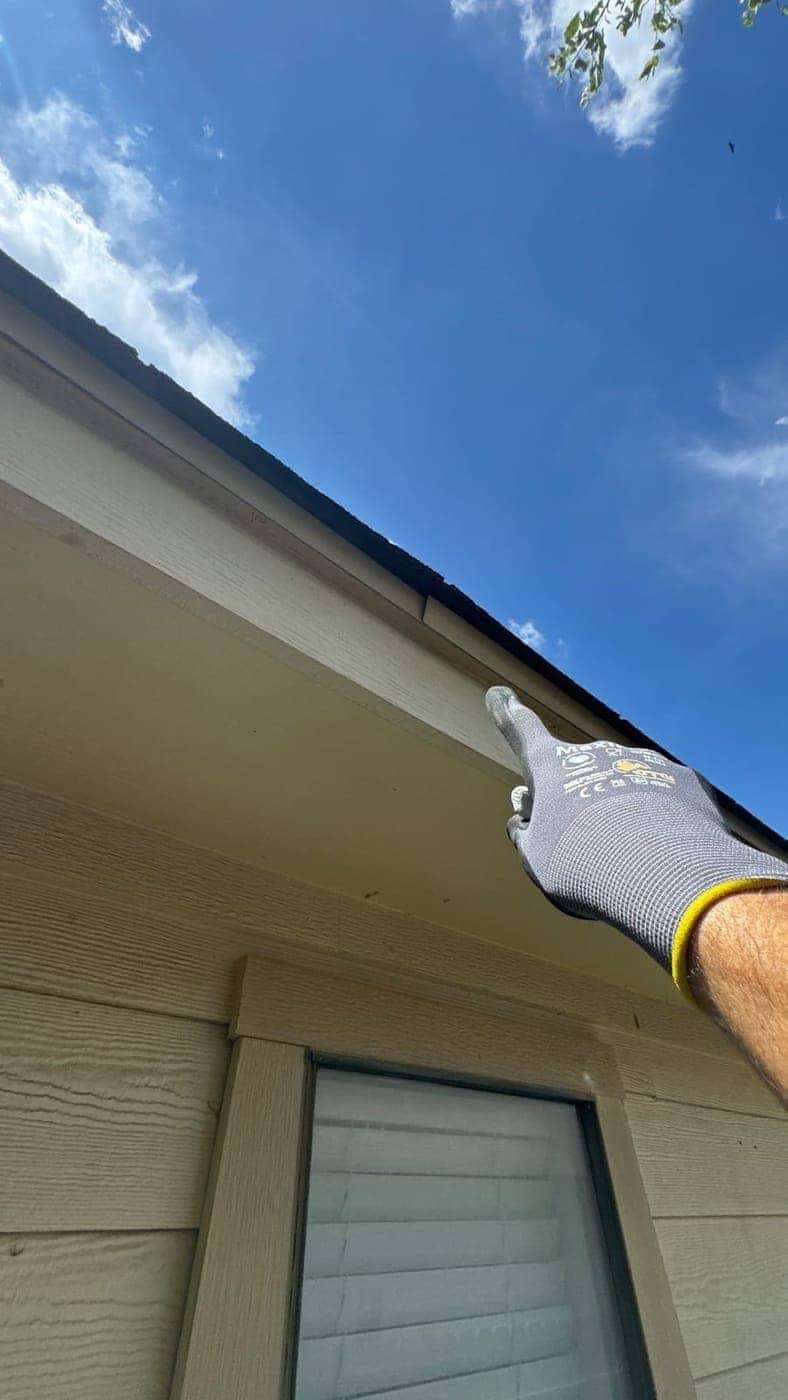
Siding trim and fascia checked in Cedar Park
Fascia and eave trim under a shingle roofline in Cedar Park, with a caulked corner seam on painted fibre-cement siding photographed close up. Exterior trim is where roof water shows up first when a detail has failed.
More at our work, and where we work. Gutters usually come off and back on with a siding job — see gutter services — and if the roof above the wall is damaged too, start at roof replacement.
Common questions
Does homeowners insurance cover hail damage to siding in Texas?
It can — siding is part of the dwelling, and hail is a covered peril on most Texas policies. Whether your damage is covered, and how the carrier treats matching, is between you and them. You file the claim; we inspect both the roof and the walls, photograph the strikes with a scale in frame, and give you the report. We do not negotiate coverage and cannot promise an outcome.
Can you match my existing siding?
On fiber cement and wood, usually, because both are finished on site and can be blended. On vinyl it is genuinely hard: profiles get discontinued and the wall you are matching has been fading in Texas sun for fifteen years. We hold panels up against the existing wall and let you look before we commit to a repair rather than a full elevation.
Do you do exterior painting?
We also offer exterior painting on request as part of an exterior project. It is not a standalone service and there is no painting page on this site.
How long does a siding job take?
A single-elevation repair is often a day or two. A full re-side runs most of a week or longer depending on the size of the house, how much rotten sheathing turns up behind the old material, and whether the trim and the wrap are being replaced with it. We photograph whatever is behind the wall before it gets covered again.
Free, no obligation
Request a free inspection
Two questions, and we call you back to schedule.
Price my roofOr call (512) 305-1111
Last updated