

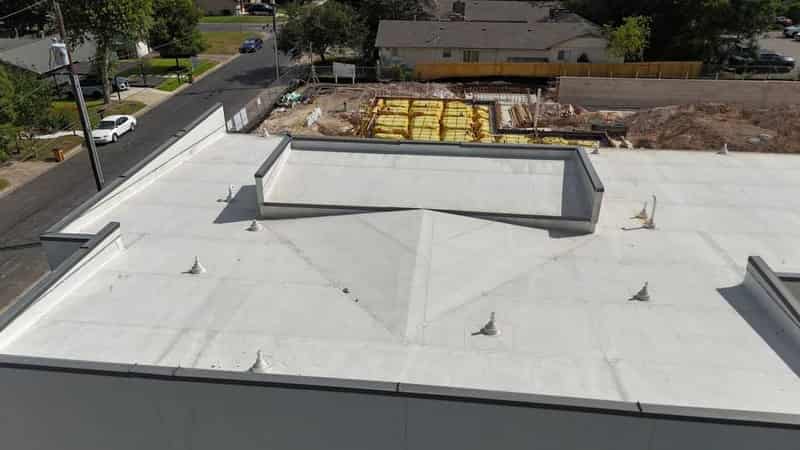
Commercial roofing
Commercial roofing contractor for Central Texas buildings
Commercial roofing across the Austin metro and the Hill Country: TPO and PVC single-ply, modified bitumen, standing-seam and R-panel metal, and coating, restoration and spray-foam systems, built, repaired and maintained by Waypoint. We install Versico single-ply systems, and the line procurement asks for first is this one: General liability insured: $1M per occurrence, $2M aggregate — certificate of insurance available on request. Our phones are answered 24/7 at (512) 305-1111. Send us the building address and the roof size and we will walk the roof, photograph it, and give you a scoped bid.
The short answer
This page is the front door to five system pages, an RFQ and a leak line. If you already know what you need, the systems are listed below. If you are working out whether this roof is a repair, a restoration or a replacement, the honest answer usually depends on what is under the membrane — so the first thing we do is get on the roof, take cores or probes where the condition warrants it, and show you the pictures before anybody writes a number down.
Who is this page for?
Three people buy commercial roofing and they are not buying the same thing. Start wherever you actually sit.
Facility and property managers
You need the water stopped, a record of what was done, and no surprises in next quarter's budget. We triage leaks by phone, trace them on the roof rather than guessing from the ceiling stain, and send a dated photo report for the building file. A maintenance agreement turns the same work into a schedule instead of an emergency — which is also the documentation most manufacturer warranties require.
Building owners and investors
Your question is capital: how many years are left in this roof, what does each option cost per square foot, and what does it do to service life and warranty. We scope the options side by side — repair, restore, recover, replace — with what disqualifies each one, so the decision is made on the condition of the deck and insulation rather than on whichever system the contractor prefers to sell.
Procurement and general contractors
You need the paperwork to clear before the crew arrives: certificate of insurance, additional-insured wording, safety posture, site access and a schedule that survives contact with the other trades. Our insurance and safety text is printed below rather than hidden behind a form, and the bid request has a box for a procurement packet.
What kinds of buildings do you work on?
Low-slope and metal buildings of the kind Central Texas is full of: multi-family and HOA common buildings, retail, office, light industrial and warehouse, and churches and schools. Those are building types we work on, not a client list — we would rather name a job when we can show you the photographs than pad this page with logos. If your building is agricultural metal, a restaurant with grease exhaust, or a mixed-use block, say so on the bid request: each of those decides which system is appropriate before anything else about the roof does.
Should we replace this roof or restore it?
That question is answered under the membrane, not on top of it. If the deck is sound and the insulation is dry, a coating or a spray-foam restoration usually costs less than a tear-off, keeps the building operating, and buys real years. If moisture has got into the insulation, coating over it seals the water in and you have bought an expensive delay — so a moisture survey comes before a restoration quote. Where a roof is genuinely at end of life, replacement is the cheaper answer measured across the next decade, and we will show you the arithmetic rather than asserting it.
What is a Waypoint bid actually going to say?
A scope, not a headline price. It names the system and the manufacturer, the insulation and cover board, the attachment method, the flashing and termination details, what we are removing and where it goes, the manufacturer warranty being offered and the workmanship term we carry ourselves, and the schedule with the access and tenant plan attached. Where a cheaper option would honestly serve the building, it is quoted as an alternate on the same page rather than left out so the total looks smaller.
Who is going to be on our roof?
Waypoint Roofing and Construction Co. was founded in Dripping Springs in 2024 by Michael and Madison Kastel, and the team brings more than 40 years of combined roofing experience. We are an installer of Versico single-ply systems, our inspectors are HAAG-certified — the damage-assessment training the insurance industry itself uses — and we are members of the Roofing Contractors Association of Texas. Texas does not license roofers, so those are the checkable things we put in front of you in place of a state credential.
Are you the right call for a house?
No — this path is for buildings. Homeowners should start on the residential side of the site, which is where inspections, replacements and storm work for houses live.
Which roof systems do you install?
Five pages, each one honest about when the system is the wrong answer as well as when it is the right one.
Single-ply: TPO and PVC
The default for most low-slope offices, retail and warehouse roofs. PVC where the roof sees kitchen grease or chemical exhaust.
Standing-seam and R-panel metal
Sloped commercial and agricultural buildings, and metal roofs that need a retrofit rather than a tear-off.
Coatings, restoration and spray foam
The membrane is failing but the deck and insulation under it are dry, and a capital tear-off is not in this budget cycle.
Leak repair and diagnosis
Water is coming in and nobody has traced it to a source yet. Includes the photo report of what we found.
Maintenance agreements
Semi-annual inspections, drain clearing and documentation that keeps a manufacturer warranty in force.
Modified bitumen is installed as well; it is compared column-by-column against TPO and PVC on the single-ply page rather than given a page of its own.
How does a commercial roof project run?
- Site walk and roof survey. We get on the roof, photograph it, measure it, and check the details that actually fail — seams, terminations, penetrations, curbs, drains and flashings.
- Scoped written bid. System options priced side by side, with what each one does to service life, disruption and warranty.
- Schedule, access and tenant plan. Agreed in writing before we mobilize: roof access, staging, parking, notification, and after-hours phases where the building cannot be disrupted.
- Build, documented daily. Photographs as the work goes on, not reconstructed afterwards.
- Closeout package. Warranty paperwork, as-built notes and the photo record, in one file you can hand to whoever manages the building next.
- Maintenance, if you want it. The new roof goes onto a semi-annual cycle so the warranty stays documented and small problems stay small.
Insurance, safety and credentials
What we carry, and what we will send before we mobilize:
Versico single-ply systems · RCAT member · General liability insured: $1M per occurrence, $2M aggregate — certificate of insurance available on request · HAAG-certified inspectors
Safety and access
Tie-off on every roof, roof-access and tenant coordination agreed before we mobilize, and after-hours work when a building cannot be disrupted.
What we commit to on a commercial site
- Tie-off on every roof. No exceptions for a five-minute look, and no crew on your roof without it.
- Access and tenants agreed before we mobilize. Roof access, staging, parking and notification settled in writing, not improvised at 7 a.m.
- Documentation as a deliverable. Dated photographs of what we found and what we did, on repairs as well as replacements.
- The certificate before the crew. Issued to your certificate holder ahead of mobilization, on request.
Commercial projects
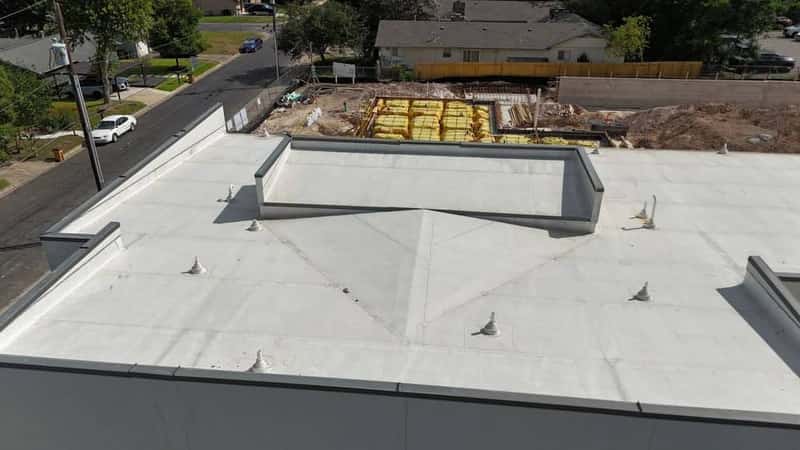
TPO membrane roof documented on an Austin commercial building
A white TPO single-ply roof on an Austin commercial building, photographed from the air and close up. The detail frames show membrane seams, sealed pipe penetrations and existing rectangular patches on the field of the roof.
Common questions
Do you provide a certificate of insurance?
Yes, before we mobilize and without being chased for it. We carry general liability at $1M per occurrence and $2M aggregate, and the certificate is available on request — tell us who the certificate holder is and whether you need an additional-insured endorsement and we will have it issued. If your prequalification process needs anything else in writing, ask on the bid request and we will tell you plainly whether we can supply it.
Can you work nights and weekends so we do not have to close?
Yes. Tear-off is loud and roof work over an occupied space is disruptive, so on retail, restaurant and office buildings we routinely schedule the noisy phases outside trading hours and stage material where it does not take your parking. It costs more per square in labour and we will show you that line in the bid rather than burying it.
Do you work with property managers and HOAs?
Yes. Multi-family and HOA common buildings are ordinary work for us, and the reporting is built for a board packet: dated photos, what we found, what we did, what we recommend next and roughly when. If you manage several buildings, we would rather survey all of them at once and give you one prioritized list than bid them one emergency at a time.
Do you do roof surveys for a capital budget?
Yes, and it is a different piece of work from a bid. A survey walks each roof, records system type, approximate age, condition, and the repairs each roof needs now versus in the next few years, and hands you a document you can put a number against in a capital plan. Some of those roofs will not need us this year. Saying so is the point of the exercise.
What warranty comes with your systems?
Two separate things. The manufacturer warrants the membrane or panel system and, on a Versico single-ply system we install, that warranty can cover the assembly rather than just the material — the term and the conditions come from the manufacturer, on the specific system, and we quote them from their paperwork rather than from memory. Waypoint separately warrants its own workmanship, and that term is written into your contract.
How fast do you respond to a leak?
Our phones are answered 24/7 at (512) 305-1111, and a live leak is triaged ahead of scoping work. What we will not do is publish a guaranteed response window we cannot honour during a regional storm, when every commercial roof in the metro calls the same morning. Call, or use the leak form, and you will get a real answer about when we can be there.
Request a commercial bid
Last updated