

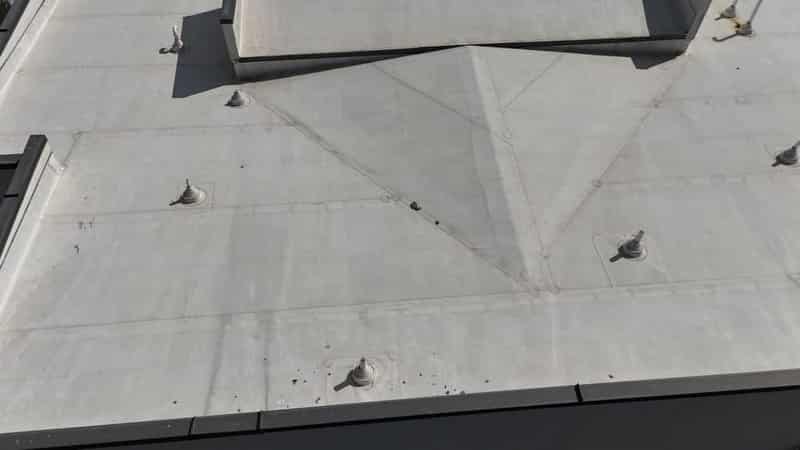
Commercial roofing
Commercial roof coatings, restoration and spray foam
If your commercial roof is leaking but the deck and insulation underneath are still dry, you may not need a tear-off. Waypoint restores low-slope roofs with silicone and acrylic coating systems and with spray polyurethane foam, which adds insulation as well as a new surface. Restoration usually costs less than replacement, disrupts the building far less, and can add real years to a roof — but only when the substrate qualifies, and we will tell you when it does not.
Restore, recover or replace — how is that decided?
By what is under the membrane, in this order. First, is the insulation dry? A moisture survey — infrared, capacitance meter, or test cuts where the survey says to — answers that, and it is the question everything else hangs on. Second, is the deck sound and are the fasteners holding? Third, is the membrane still bonded and still coatable, and has this roof already been covered as many times as the code allows? A roof that passes all three is a restoration candidate, and restoring it is the cheaper answer. A roof that fails the first is a replacement — or a replacement of the wet portion and a restoration of the rest.
What does a restoration actually involve?
More preparation than coating. We clean the roof properly, because coatings bond to the surface they are given; we make the repairs — seams, splits, blisters, failed flashings and pitch pockets; we replace saturated insulation where the survey found it; we reinforce every detail, penetration and change of plane with fabric embedded in coating, because that is where the movement is; and only then does the field get its base and top coats at the specified thickness. Anyone who quotes a restoration as a price per square foot for coating alone has quoted you the last twenty per cent of the job.
Silicone or acrylic?
Silicone tolerates standing water, which matters on Central Texas roofs with lazy drainage, and it holds up well to ultraviolet exposure; it is more expensive, it is slippery when wet, and it attracts dirt, so reflectivity falls unless the roof is washed. Acrylic costs less, is easier to work with, re-coats cleanly and holds its brightness better, but it does not want to sit in ponding water and it needs proper cure conditions to go on at all. On a roof that drains well, acrylic is often the sensible economy. On a roof with ponding you cannot fix, silicone is usually the only honest coating answer — and if the ponding is severe, the real answer is foam or drainage correction, not a coating at all.
Is spray polyurethane foam a better option than a coating?
SPF is a different product doing a different job. It is sprayed as a liquid that expands into a closed-cell foam, bonds fully to the substrate, self-flashes every penetration and parapet without a seam anywhere, and adds genuine insulating value to a building that may have had little. Because it is applied at variable thickness it can also be tapered to move water off a roof that has never drained properly — the one thing no coating can do. The price is real: foam needs a dry, sound, well-prepared substrate, tight weather windows for application, and a coating over it that must be maintained and re-coated on schedule, because unprotected foam degrades in ultraviolet light. Foam is the right call where the roof needs insulation or drainage as well as a surface, and the wrong call where it only needs a surface.
What happens if the survey finds wet insulation?
We show you where, on a marked-up roof plan with photographs, and price the removal and replacement of those areas as part of the scope rather than as a change order later. Wet areas are usually a fraction of a roof, and cutting them out is what makes the rest of the restoration legitimate. If the survey finds saturation across most of the field, restoration is off the table and we will say so in plain terms — that is a replacement, and pretending otherwise would cost you the price of a coating and then the price of a roof.
What does a restoration commit you to afterwards?
A schedule. A restored roof is a maintained roof: the coating is inspected, the details are checked, the surface is kept clean so it keeps reflecting, and it is re-coated before it fails rather than after. Manufacturer system warranties on restorations carry exactly those obligations, and a lapsed inspection record is the usual reason a warranty claim is refused.
How our maintenance agreements work
How should we budget for this?
Restoration sits between repair and replacement in cost and moves the replacement out several budget cycles, which is usually the point of doing it. What we can put in front of a finance committee is a scoped price for this roof, the condition evidence behind it, the cost of the re-coat cycle when it comes, and what a replacement would cost instead. We publish no price per square foot here, because the honest number depends on your roof and a band typed from memory is worth nothing in a capital plan.
Insurance, safety and credentials
What we carry, and what we will send before we mobilize:
Versico single-ply systems · RCAT member · General liability insured: $1M per occurrence, $2M aggregate — certificate of insurance available on request · HAAG-certified inspectors
Safety and access
Tie-off on every roof, roof-access and tenant coordination agreed before we mobilize, and after-hours work when a building cannot be disrupted.
Restoration and coating projects
Restoration photo reports, including before-and-after sets, are being prepared for publication — building type, system and square footage will be named here as each one is released.
Single-ply systems · Metal · Maintenance agreements · Our work
Common questions
Should I restore this roof or replace it?
Restore when the deck is sound, the insulation is dry, the existing membrane is still bonded and the failures are at seams, details and the surface. Replace when moisture is in the insulation, the deck needs work, the assembly cannot take another layer, or the roof has already been recovered to the limit the code allows. The survey answers it; the age of the roof by itself does not.
Can you coat a roof with wet insulation?
No, and anyone who offers to is selling you a delay. A coating is a vapour-retarding surface: seal it over saturated insulation and the water stays, keeps degrading the deck and fasteners, and destroys the thermal performance you are still paying to heat and cool. The fix is to cut out and replace the wet areas first — which is usually a modest fraction of the roof — and then restore the rest.
Is spray polyurethane foam better than a coating?
They do different jobs. A coating renews a surface. Foam adds a new, seamless, self-flashing layer with real insulating value and can be sloped to correct ponding, which no coating can do. Foam also costs more, is more sensitive to weather and substrate during application, and must be coated and re-coated to survive ultraviolet exposure. If the roof needs insulation or drainage correction as well as a surface, foam earns its price. If it only needs a surface, it does not.
Will a restoration come with a manufacturer warranty?
Manufacturers do offer system warranties on restoration and foam assemblies, and they are conditional: the substrate has to pass an adhesion or moisture test, the coating has to go on at the specified thickness, and the roof has to be inspected and re-coated on schedule. We quote the term and the conditions from the manufacturer paperwork on your assembly rather than printing a headline number on a web page. Waypoint separately warrants its own workmanship for the term in your contract.
How disruptive is a restoration compared with a tear-off?
Much less. There is no tear-off noise, no open deck and no disposal traffic, and the crew is smaller. What you do get is odour and equipment during application, so occupied buildings with fresh-air intakes on the roof need those shut down or masked while we work over them. That gets planned before we mobilize, not discovered on day one.
Request a commercial bid
Last updated