

Commercial roofing
Commercial roof leak repair and diagnosis in Central Texas
A leak in a low-slope roof rarely enters the building where it enters the roof. Waypoint traces commercial leaks to the actual source — seams, terminations, penetrations, drains, curbs and flashings — repairs them, and sends you a photo report of what we found and what we did. Our phones are answered 24/7 at (512) 305-1111. If water is coming into your building right now, use the leak form and we will triage it.
How do you find where the water is actually getting in?
We start inside, because the interior tells us what the roof cannot: where the stain is, what is directly above it, whether the water arrives during rain or hours later, and whether it only shows up when the wind is from one direction. Then we get on the roof and work the likely sources in order — seams and laps, terminations and edge metal, penetrations and pipe boots, curbs around equipment, drains and scuppers, and any place a trade has fastened something down since the roof went on. Where the entry point is not obvious, we test: flooding a drain, isolating an area, or opening a small test cut to see whether the insulation beneath is wet and in which direction it dries. The test cut is patched before we leave.
Where do leaks come from on each system?
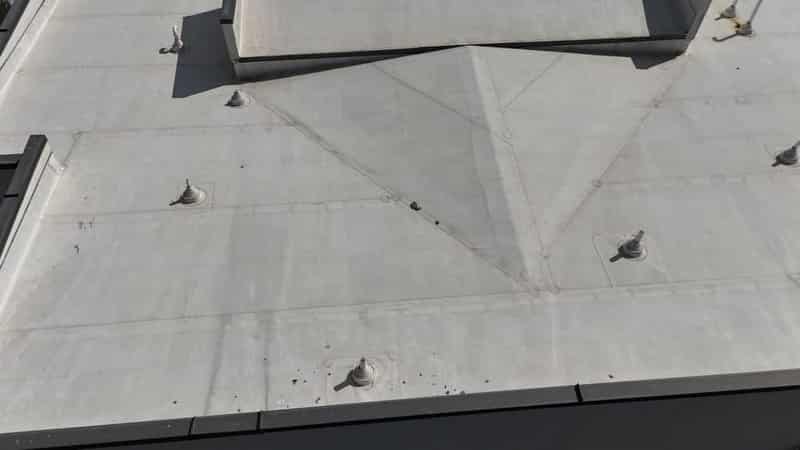
On single-ply, it is nearly always seams, terminations and penetrations — a weld that was never fully fused, a termination bar whose sealant has given up, a boot that has split. On modified bitumen, it is laps, blisters and the flashings up walls and curbs. On metal, it is fasteners and their washers, panel laps, and any flashing at a headwall or a curb added later. On a coated roof, it is the details — the places where movement concentrates and the coating was applied thin. On every one of them, the drains are worth checking first, because a blocked drain turns a small failure into a pond over it.
What can you do today, and what has to wait?
Stabilisation and permanent repair are different work. If a roof is taking water in a storm, the immediate job is to stop the interior damage — dry-in the failed area, clear the drains, protect what is below — and that can often be done in conditions where a permanent repair simply will not bond. Membrane and coating repairs need a dry, clean substrate and a temperature window, so we come back and do the real repair properly rather than smearing mastic in the rain and calling it finished. We will tell you plainly which one we are doing on the day.
What do you hand over when the repair is done?
A short report you can file: dated photographs of the failure, of the work in progress and of the completed detail, the location marked on a roof plan, a description of the cause rather than just the symptom, and a recommendation — this detail is now sound, these three other details are heading the same way, this roof needs a survey before next summer. Facility managers need that document for the building file and for warranty compliance, and owners need it because it is the only record that turns roof spending into an asset history rather than a series of invoices.
When do repeated leaks mean the roof is finished?
When the failures stop being events and start being a pattern. Three signs matter more than the roof's age: leaks appearing in new locations each season rather than recurring in the same one; a membrane that has become chalky and brittle, so patches no longer bond reliably; and a moisture survey that finds wet insulation across a meaningful share of the field. At that point every repair is money spent on a roof you are still going to replace, and the right conversation is whether it is a restoration or a replacement.
How do we stop paying for the same leak twice?
By putting the roof on a schedule instead of a fire alarm. Most of what we repair in an emergency was visible months earlier as a lifting seam, a blocked drain or a split boot, and would have taken ten minutes to fix on a routine visit. A maintenance agreement covers exactly that: semi-annual walks, drains cleared, details checked, small repairs made on the spot, and a photo report each time — which is also the documentation most manufacturer warranties require you to be able to produce.
Insurance, safety and credentials
What we carry, and what we will send before we mobilize:
Versico single-ply systems · RCAT member · General liability insured: $1M per occurrence, $2M aggregate — certificate of insurance available on request · HAAG-certified inspectors
Safety and access
Tie-off on every roof, roof-access and tenant coordination agreed before we mobilize, and after-hours work when a building cannot be disrupted.
Leak diagnosis and repair
Leak diagnostic photo sets are being prepared for publication — building type, system and the cause we traced will be named here as each one is released.
Common questions
How fast can you respond to a commercial roof leak?
Our phones are answered 24/7 at (512) 305-1111 and a live leak is triaged ahead of scoping work. We do not publish a guaranteed response window, because the honest answer changes on the day a hailstorm crosses the metro and every building manager in Central Texas calls the same morning. Call or send the leak form and you will get a real time from a person, not a number written on a web page months ago.
Why is my flat roof leaking in a different place from the ceiling stain?
Because water travels. It enters at a failed detail, runs between the membrane and the insulation or along the top of a deck flute, and drops through at the first opening it finds — a deck seam, a fastener, a conduit penetration — which can be many feet from the entry point and often uphill of your intuition. That is why we survey the roof rather than repairing whatever is nearest to the stain, and why guessing is the most expensive way to fix a leak.
Should we repair this roof again or replace it?
Count the repairs. Isolated failures at details on a sound membrane are repairs, and repairing them is far cheaper than a roof. When leaks are appearing in new places every season, when the membrane is chalked and brittle so patches will not bond, or when a moisture survey shows the insulation is already wet across the field, you are paying repeatedly for a roof you will still have to replace. We will tell you which of those two you have, in writing, with the photographs.
Do you provide a written repair report?
Every time. You get dated photographs of the failure before we touch it, of the repair in progress, and of the finished detail, with a short written note of what we found, what we did and what we recommend next. It goes in the building file, it supports a warranty or a claim record if one is ever needed, and it means the next person to manage the building is not starting from zero.
Do you work after hours so we do not have to close?
Yes. Most leak repairs are small, quiet work that can be done in business hours without anyone below noticing, but where a repair sits over a trading floor, a classroom or a clinical space we will schedule it around your operation. Access, escort requirements and after-hours procedure get agreed when the job is booked rather than negotiated at the door.
Request a commercial bid
Last updated