

Commercial roofing
TPO and PVC single-ply roofing for Central Texas buildings
TPO and PVC are heat-welded single-ply membranes, and they are the two systems most Central Texas low-slope buildings get today. Waypoint installs Versico single-ply systems, so the manufacturer can warrant the system we build rather than the material alone. TPO is the cost-efficient default for most offices, retail and warehouse roofs; PVC costs more and is the right call where the roof sees kitchen grease, chemical exhaust or heavy foot traffic. Send us the building address and roof size and we will walk it and price both.
What is actually in a single-ply roof?
Five layers, and four of them are invisible once the job is finished. The structural deck carries the load. Insulation above it, usually polyiso board, does the thermal work. A cover board protects the insulation from hail and foot traffic and gives the membrane something stable to bond to. The membrane is a single sheet of TPO or PVC — mechanically fastened, induction-welded or fully adhered, depending on the deck, the wind zone and the building's height. Then the details: flashings up every wall and curb, terminations, pipe boots, drains and pitch pockets. Roofs almost never fail in the middle of the field. They fail at the details, which is where the labour and the skill go.
When is TPO the right call?
On most Central Texas low-slope buildings. TPO is a white, reflective sheet that keeps roof surface temperature down through a long Texas summer, and hot air welds it into what is effectively one continuous sheet with no adhesive seams to fail. It carries the lowest installed cost of the three systems in the table below, and a thicker membrane over a proper cover board buys meaningful hail resistance for a modest uplift. It is the default for office, retail, warehouse and light industrial roofs.
When is PVC worth the extra cost?
When the roof meets chemistry. PVC resists grease, animal fats, solvents and many chemical exhausts that will soften and degrade TPO — so restaurants, commercial kitchens, food-processing plants and buildings with laboratory or industrial stacks get PVC, and the price difference is cheap compared with re-roofing early. PVC is also the more forgiving sheet where a roof carries regular foot traffic to equipment, and it can be welded into walkway pads and detail work that would be awkward in TPO. If your building has none of those conditions, PVC is money spent on a property you will not use.
Why do TPO and PVC seams fail?
Almost always because of how they were welded, not what they were made of. A hot-air weld has a narrow window: too cold and the sheets are stuck rather than fused, too hot and the membrane is scorched and brittle, and both look identical from a ladder. A weld made on a dusty or damp sheet, or made at the wrong speed by a hand welder at a corner the robot cannot reach, is the one that opens two winters later. That is why we probe seams with a hooked tool as we go instead of trusting the appearance, and why seam and termination checks are the first thing on a maintenance visit.
What punctures a single-ply membrane?
People and equipment, not weather. Dropped tools, a service technician dragging a condenser across the field, screws left after an HVAC repair, and hail on an unprotected, unsupported membrane are the usual causes. The defence is a cover board under the membrane, walkway pads on the routes technicians actually take rather than the routes a drawing says they take, and a maintenance visit that finds a puncture while it is still a small hole rather than after the insulation under it has taken a season of water.
Why does a membrane lose adhesion?
On a fully adhered roof, an unbonded area is usually a preparation failure: adhesive applied to a dusty, damp or too-cold substrate, or the sheet laid outside the adhesive's flash-off window. On a mechanically fastened roof, the equivalent failure is a fastener backing out through the plate, which shows itself as flutter in high wind. Neither is visible from the ground. Both are visible on a roof walk, and both are cheap to fix before the wind finds them.
What does Texas sun do to a roof membrane?
Ultraviolet exposure and heat age the top surface of any membrane and consume the stabilisers that protect it, which is why a chalky, crazed surface on an older roof is a genuine condition signal rather than a cosmetic one. A reflective sheet runs cooler and ages more slowly, and keeping the roof clean matters, because dirt destroys reflectivity. It is also why we will not guess a service life from a roof's age alone — a clean, well-drained roof and a ponding, filthy one of the same age are not the same roof.
Tear-off or re-cover?
A re-cover leaves the existing system in place and installs new insulation or cover board and a new membrane over it: faster, quieter, cheaper, and no disposal cost. It is only available when the existing system is dry, the deck is sound, and the code limit on roof coverings has not been reached. A tear-off is the honest answer when moisture has got into the insulation, when the deck needs attention, or when the assembly cannot take fasteners. We would rather lose the cheaper sale than sell you a roof over a wet one.
What happens to your operations while we work?
Tear-off is the loud phase and welding is the smelly one, so both are planned around your tenants. Before we mobilize we agree roof access, staging and parking, tenant notification, and which phases run after hours. The roof is left watertight at the end of every working day — never open overnight — and we photograph progress daily.
| TPO | PVC | Modified bitumen | |
|---|---|---|---|
| What it is | Thermoplastic polyolefin sheet, usually white, welded with hot air. | Plasticised polyvinyl chloride sheet, welded with hot air. | Asphalt sheet reinforced with polyester or fibreglass, in one or two plies. |
| Seam method | Hot-air weld — a fused, monolithic seam. | Hot-air weld — a fused, monolithic seam. | Torch-applied, hot asphalt, cold adhesive or self-adhered lap. |
| Grease and chemical resistance | Poor against grease, fats and solvents. | Strong — the reason it exists on restaurant and process roofs. | Moderate; asphalt is degraded by petroleum-based products. |
| Foot-traffic tolerance | Adequate with a cover board and walkway pads. | Good, and walkway pads can be welded in. | Good — the thickest surface of the three underfoot. |
| Reflectivity and heat | High as installed, in white; reflectivity falls as the surface soils. | High as installed, in white; same soiling caveat. | Low unless granulated or coated in a reflective finish. |
| Repairability | Welded patch, no adhesive; easy where the sheet is still weldable. | Welded patch; the most forgiving of the three to detail around. | Patched with compatible mastic and sheet; messier but very familiar. |
| Where it fits | Offices, retail, warehouse and light industrial with ordinary rooftop equipment. | Restaurants, food processing, laboratories and buildings with chemical exhaust. | Small, heavily penetrated roofs and buildings with fixed traffic routes. |
| Typical installed cost per square foot | Not published yet | Not published yet | Not published yet |
| Expected service life in Central Texas | Not published yet | Not published yet | Not published yet |
| Manufacturer warranty term | Not published yet | Not published yet | Not published yet |
| Waypoint installs it? | Yes — Versico single-ply systems. | Yes — Versico single-ply systems. | Yes. |
- Cost, service-life and warranty-term cells are deliberately empty. Waypoint publishes a number here only when it is sourced from a manufacturer data sheet or from our own completed jobs, cited and dated. A price band typed from memory is worth nothing to a capital plan.
- Warranty terms are quoted to you from Versico paperwork on the specific assembly proposed for your building.
Insurance, safety and credentials
What we carry, and what we will send before we mobilize:
Versico single-ply systems · RCAT member · General liability insured: $1M per occurrence, $2M aggregate — certificate of insurance available on request · HAAG-certified inspectors
Safety and access
Tie-off on every roof, roof-access and tenant coordination agreed before we mobilize, and after-hours work when a building cannot be disrupted.
Single-ply projects
TPO membrane roof documented on an Austin commercial building
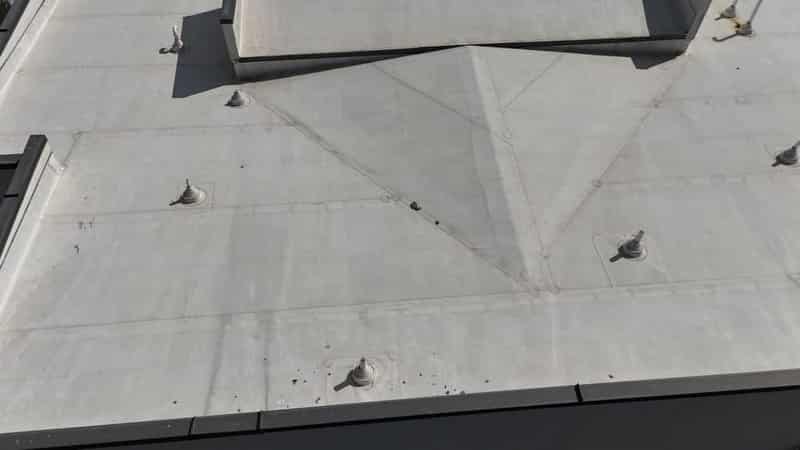
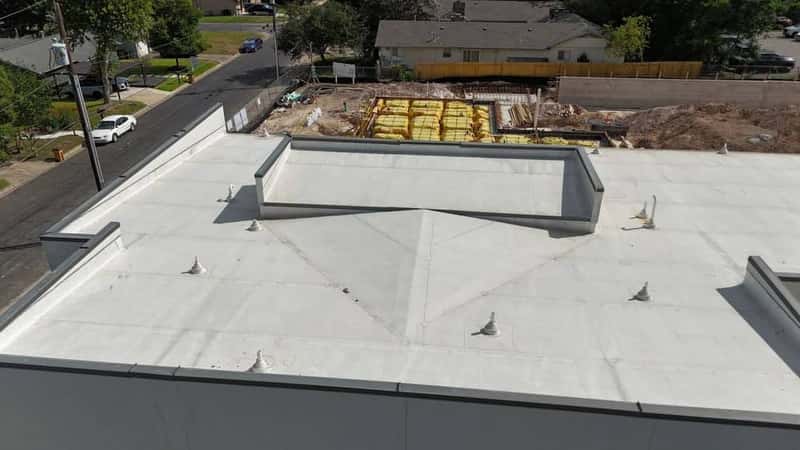
A white TPO single-ply roof on an Austin commercial building, photographed from the air and close up. The detail frames show membrane seams, sealed pipe penetrations and existing rectangular patches on the field of the roof.
Coatings and restoration · Leak repair · Maintenance agreements · Our work
Common questions
TPO or PVC — which is right for my building?
TPO for most offices, retail and warehouse buildings: it costs less per square, it is white and reflective, and it welds into a monolithic sheet. PVC where the roof will see kitchen grease, animal fats, chemical exhaust or solvent — the plasticised sheet tolerates them and TPO does not. If your roof has a restaurant hood, a laboratory stack or a food-processing exhaust anywhere near it, that single fact usually decides the membrane before anything about price does.
Can you re-cover our existing roof instead of tearing it off?
Sometimes, and the decision is made by what is under the membrane. A re-cover over dry, sound insulation avoids the disruption and the disposal cost of a tear-off. Wet insulation, a failing deck, or a roof already carrying two systems rules it out — building codes limit how many roof coverings a deck may hold, and burying wet insulation guarantees you pay for the same roof twice. We probe or core before we recommend one.
What warranty comes with a Versico system?
The manufacturer offers a range of system warranties whose length and conditions depend on the membrane thickness, the attachment method and the details we install, and we quote yours from Versico paperwork on your specific assembly rather than printing a headline number here. Separately, Waypoint warrants its own workmanship for a term written into your contract. Both warranties normally require documented maintenance, which is why the maintenance agreement exists.
Can you work around our business hours?
Yes. Single-ply work is noisier during tear-off and fastening than during welding, so the phases that would disrupt tenants can be scheduled outside trading hours, and material staging can be arranged so it does not consume your parking. It is a real line item in the bid rather than a favour, and we would rather show you the cost than surprise you with the noise.
Do you install modified bitumen too?
Yes. Mod-bit still earns its place on small, heavily penetrated roofs, on roofs with foot traffic in fixed paths, and where a torch-free self-adhered or cold-applied system suits the building. It is compared against TPO and PVC in the table above rather than being sold as a default.
Request a commercial bid
Last updated